

02.11.2026
It’s the quantity that matters: How Gut Archaea Activate the Immune System
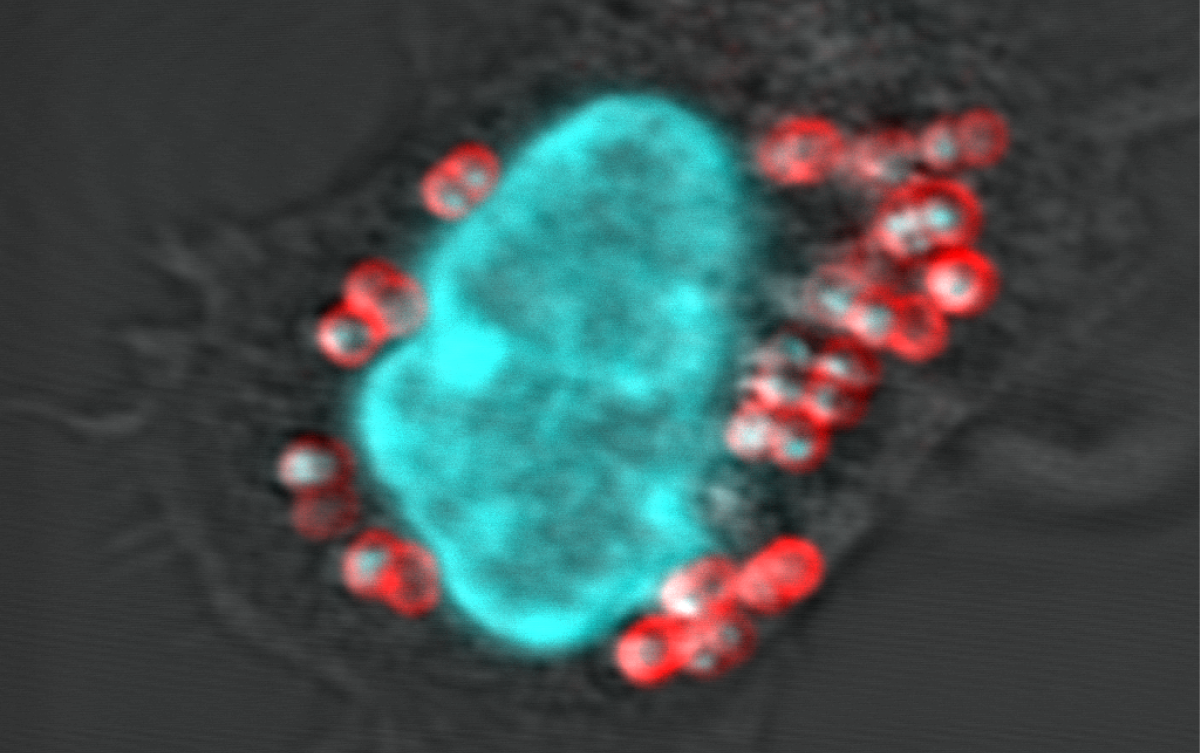
How does the human immune system recognise archaea that naturally occur in the gut? A research team from the Research Center Borstel, Leibniz Lung Center (FZB) and the Medical University of Graz has investigated how immune cells respond to the two common gut archaea, Methanosphaera stadtmanae and Methanobrevibacter smithii. The findings show that both species trigger a similar immune response, but differ in the speed and magnitude of immune activation. The amount of archaeal RNA taken up by immune cells appears to be the decisive factor.
Archaea are a distinct group of microorganisms that make up a relevant proportion of the microbial community in the human gut. They are involved in metabolic processes and have also been linked to conditions such as colorectal cancer and other intestinal diseases. Unlike many bacteria, archaea lack typical cell wall components such as lipopolysaccharides (LPS), which the immune system commonly uses to recognise pathogens. Until now, how immune cells detect archaea and respond to them has been only poorly understood.
With support from the Data Science research group led by Inken Wohlers at Borstel, the team around Holger Heine and first author Fan Xu investigated which genes are activated in blood cells from healthy donors following exposure to the two archaeal species. Both species trigger a shared core response involving 443 genes, predominantly associated with antiviral and pro-inflammatory processes. However, M. stadtmanae activates just over half of these genes (56%) markedly earlier, while the remaining 44% are induced to a similar extent by both species. At the same time, the researchers observed that human immune cells take up M. stadtmanae both more rapidly and in substantially greater numbers. After just one hour, 48% of the monocytes examined had taken up at least one M. stadtmanae cell, compared with only 7% for M. smithii.
The amount of RNA taken up makes the difference
Both archaeal species are recognised through their RNA by Toll-like receptor 8 (TLR8) inside immune cells. RNA isolated from the two species triggers immune responses of equal strength, indicating that the difference lies in the amount of RNA taken up by the cells. The researchers identified two groups of genes with different activation thresholds: inflammatory mediators such as IL-6 and TNF require a strong signal and are regulated via the transcription factor NF-κB. Other genes, including important chemokines and interferons, are activated even at low RNA levels through the STAT1/2 signalling pathway.
Contact

Prof. Dr. Holger Heine
Leiter der Forschungsgruppe "Angeborene Immunität"
+49 4537 / 188-4200
"For a long time, we did not understand how such different activation programmes could be regulated through one and the same receptor. It was only when experimental evidence revealed different activation thresholds for different classes of genes that we were able to elucidate the underlying molecular mechanism," explains Holger Heine, Head of the Research Group „Innate Immunity“ at the FZB.
New perspectives for research into immune responses and disease
The TLR8 receptor is a target of therapeutic agents currently undergoing clinical evaluation for cancer and hepatitis B treatment, as well as for use as vaccine adjuvants. The mechanism described in the latest issue of the journal Nature Communications suggests that immune responses could potentially be modulated in a dose-dependent manner by adjusting the strength of the TLR8 signal. The abundance of archaea in the gut may also prove useful as a biomarker in the future.
"Archaea are of interest not only in the context of colorectal cancer, but also in small intestinal disorders such as intestinal methanogen overgrowth (IMO), in which methane-producing microorganisms play a role. The finding that the human immune system can recognise archaeal RNA and respond to these microorganisms opens up new perspectives on the interactions between archaea, the immune system and human health," explains Christine Moissl-Eichinger of the Medical University of Graz.
Publication: Xu, F., Sieverding, J., Zhou, P. et al. Differential methanogenic archaea-induced TLR8-dependent signaling engages gene classes regulated by NF-κB p65 and STAT1/2. Nat Commun 17, 11116 (2026). https://doi.org/10.1038/s41467-026-78885-z.