

07.07.2026
Non-Small Cell Lung Cancer: Cells within the excluded stroma that have been neglected reveal which patients have a good prognosis
The “Histology” research group at the Borstel Research Center, Leibniz Lung Center has identified a simple yet meaningful cell pattern in the connective tissue surrounding the tumor that provides important clues about long-term survival in patients with non-small cell lung cancer.
When examining immune cells in tumor tissue, researchers usually focus on where the cells are actually attacking the tumor. A study led by Sebastian Marwitz of the Borstel Research Center, Leibniz Lung Center (FZB) now shows that even immune cells that never make it to the tumor cells and instead get trapped in the surrounding connective tissue—the stroma—carry crucial information about the course of the disease.
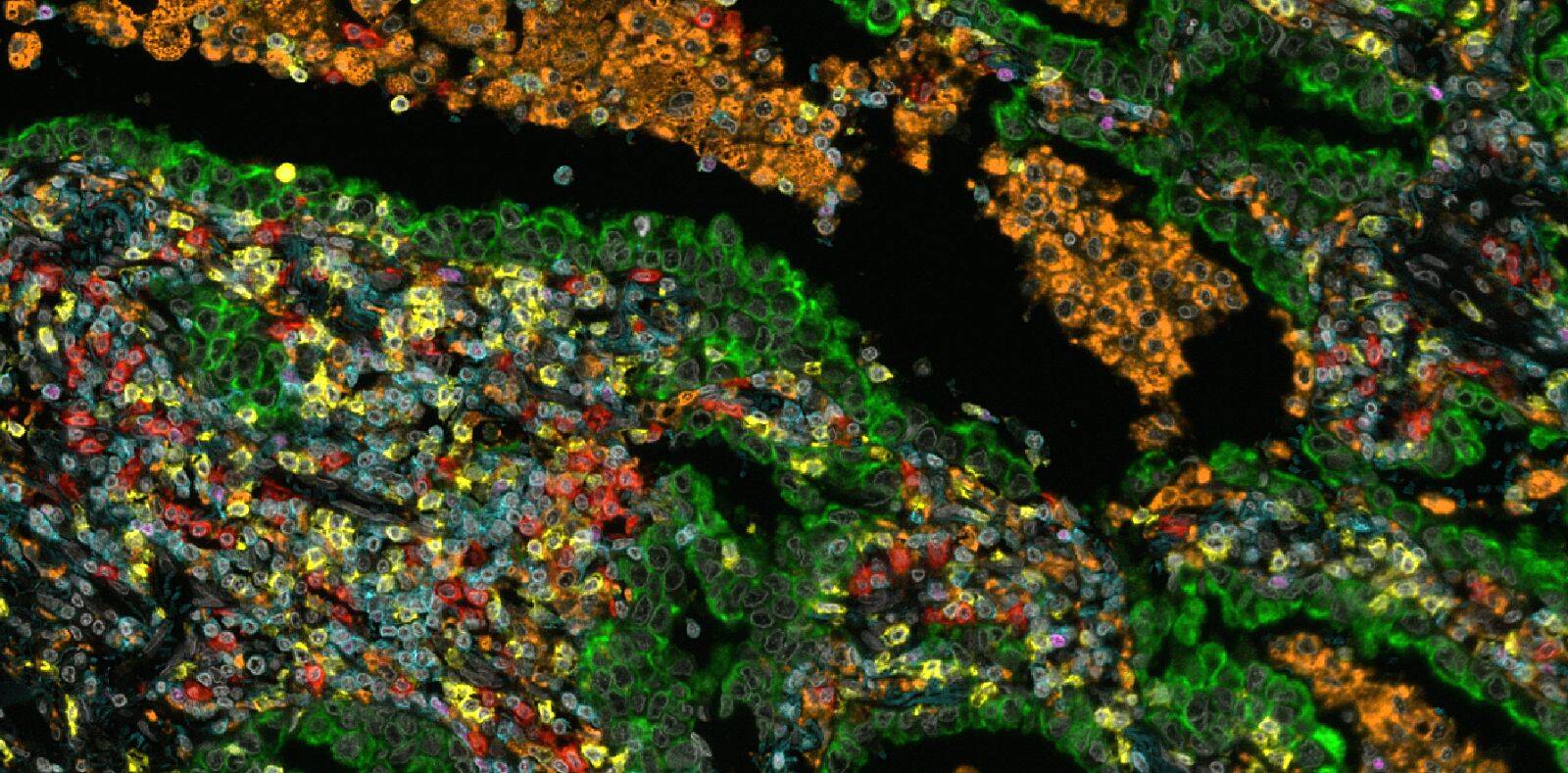
For the study, published in the European Journal of Cancer, tissue samples from 674 patients with non-small cell lung cancer (NSCLC) from Germany and Sweden were analyzed. Using state-of-the-art imaging techniques—multiplex immunofluorescence—more than six million individual cells were recorded and then classified according to their immune cell type and their exact location within the tissues.
The team identified five recurring patterns in the composition of immune cells within the stroma, as well as three distinct spatial arrangements. What was decisive was not only which and how many cells were present in the stroma, but also how they were arranged relative to one another: The spatial architecture of the immune cells in the stroma exerted an independent, clearly measurable effect on survival—a correlation that had not previously been described in this form. “This illustrates that diseases behave in more complex ways than previously thought, and that it is not just a matter of which cell type occurs and how frequently, but rather with which other cells it tends to form a neighborhood. This research approach is a central component of our work at the Research Center and at the German Center for Lung Research,” said PD Dr. Sebastian Marwitz.
Of particular clinical relevance is the fact that the pattern could be reduced to three well-established markers—B cells, helper T cells, and regulatory T cells. Such a test could be implemented with significantly less technical effort than the high-resolution multiplex methods required for basic research. Follow-up studies will now examine whether the signature pattern is also confirmed in advanced or metastatic lung cancer, as well as in patients undergoing immunotherapy.
The study is part of the research conducted by the Airway Research Center North (ARCN) at the German Center for Lung Research (DZL) and was carried out in collaboration with Uppsala University and the LungenClinic Grosshansdorf.
“We would like to extend our special thanks to all members of this international consortium. The successful implementation of this project was only possible thanks to the combined expertise, close collaboration, and shared commitment of numerous partners worldwide. Such a scientific achievement does not come about through the efforts of a single individual—it is the result of a strong international community,” said Prof. Dr. Torsten Goldmann, Head of the „Histology“ research group at the FZB.
Reference:
Marwitz S, Brunnström H, Gulyas M, et al. Left behind but not left alone: Excluded cell populations in the non-small cell lung cancer stroma predict superior long-term overall survival. European Journal of Cancer 2026 Jun 9:244:116868. DOI: 10.1016/j.ejca.2026.116868
Kontakt

PD Dr. rer. nat. Sebastian Marwitz
Stellvertretender Leiter der Forschungsgruppe "Histologie"
T +49 4537 / 188-6273
smarwitz@fz-borstel.de

Prof. Dr. rer. nat. Torsten Goldmann
Leiter der Forschungsgruppe "Histologie"
T +49 4537 / 188-2310
tgoldmann@fz-borstel.de