

11.11.2026
New grant supports development of antibiotics against tuberculosis
The Research Center Borstel, Leibniz Lung Center is a partner in a research project funded by the Novo Nordisk Foundation with 10 million Swedish kronor (approx. 900,000 €). The three year project, called SafeGM, aims to develop safer and more effective antibiotics against tuberculosis (TB). TB remains one of the world's deadliest infectious diseases, claiming more than one million lives each year.
“The spread of drug-resistant tuberculosis highlights the urgent need for new antibiotics with novel mechanisms of action. We are pleased that our three-year project, SafeGM, has received the Novo Nordisk Foundation’s Infectious Diseases Catalyst Grant 2026. The grant will support the development of new and safer antibiotics”, say Prof. Dr Philipp Klahn, Associate Professor at the University of Gothenburg, and PD Dr Norbert Reiling, Research Group leader at Research Center Borstel, Leibniz Lung Center (FZB). The new drug candidates will be synthesized in Prof. Klahn’s laboratory at the University of Gothenburg. Subsequently, the Microbial Interface Biology research group, led by Dr Reiling at the FZB, will comprehensively evaluate their activity against the bacterium that causes tuberculosis
A second chance for a promising antibiotic
SafeGM focuses on griselimycin, a naturally occurring antibiotic that is active against Mycobacterium tuberculosis, including drug-resistant strains. Unlike many existing tuberculosis drugs, griselimycin targets DnaN. This protein is essential for bacterial DNA replication, and thus for the pathogen’s reproduction.
Further development of griselimycin has so far been hindered by unwanted interactions with a human liver transporter, raising concerns about possible side effects. ”Findings of the German BMBF funded NaPAnti consortium suggest that chemical modifications can substantially reduce unwanted interactions between Griselimycin and a human transport protein without compromising its antibacterial activity. With support from the Novo Nordisk Foundation for SafeGM, we can build on these findings and take the next steps towards safer and more effective tuberculosis treatments,” says Philipp Klahn.
Contact

Prof. Dr. Norbert Reiling
Leiterin der Forschungsgruppe "Mikrobielle Grenzflächenbiologie"
+49 4537 / 188-4860
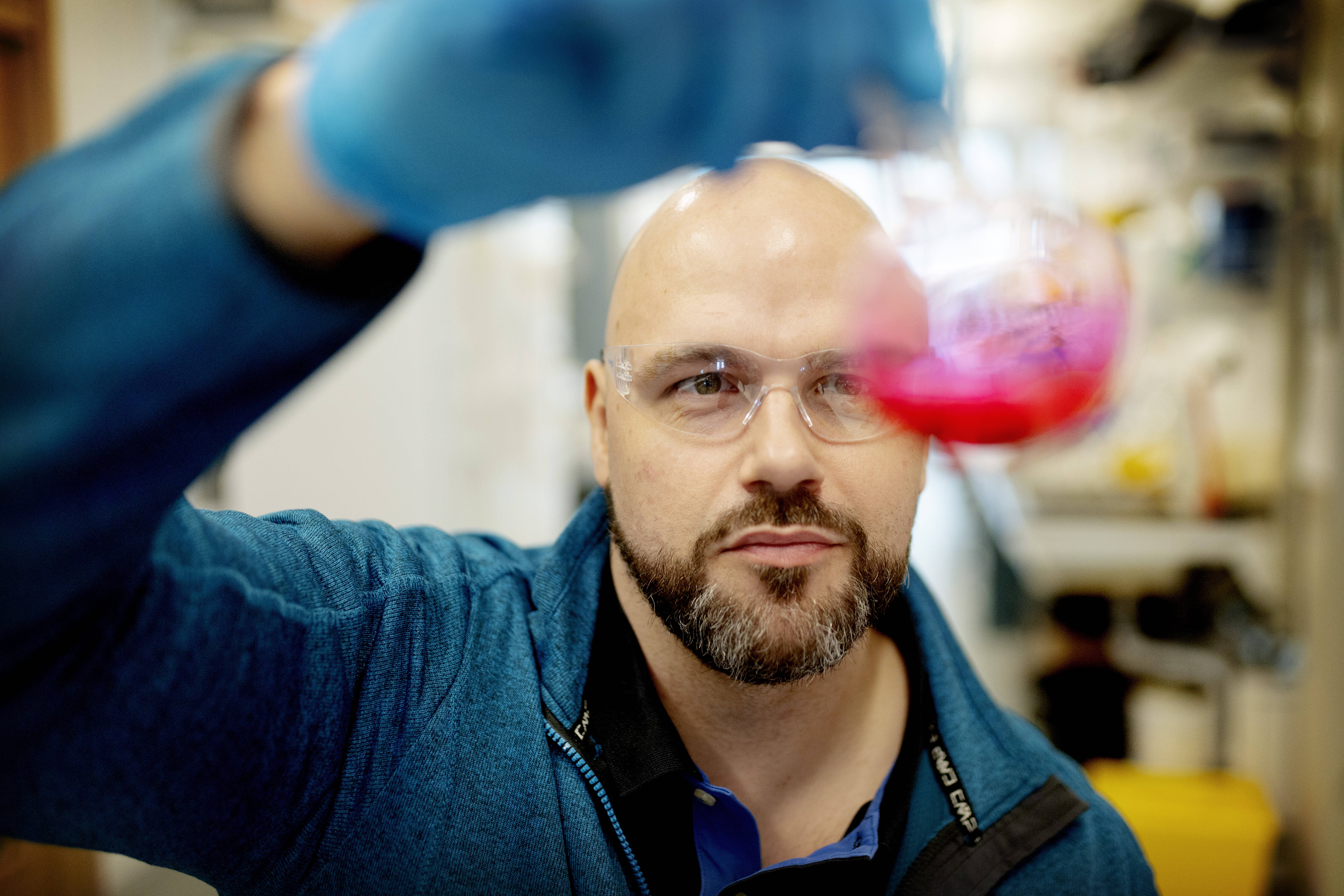 Professor Philipp Klahn of the University of Gothenburg is coordinating the SafeGM project – carried out in collaboration with the FZB and funded by the Novo Nordisk Foundation – which aims to develop new treatments for tuberculosis. Photo: Malin ArnessonInternational collaboration to advance antibiotic development
Over the next three years, the researchers will combine computer-aided molecular design, medicinal chemistry, microbiological testing, and pharmacological studies. Their aim is to develop improved griselimycin derivatives that may be suitable for oral administration. The project seeks to identify advanced antibiotic lead compounds suitable for further preclinical development against both drug-sensitive and drug-resistant tuberculosis.
“A key objective is to identify safe griselmycin derivatives that are highly effective against both intracellular tuberculosis bacteria and a broad range of antibiotic-resistant strains,” explains Reiling. “This funding enables us to bring together complementary expertise and build on many years of research to open up new therapeutic opportunities,” adds Klahn.
SafeGM project information
For the project, SafeGM – Rational and structure-guided development of safe Griselmycin derivatives for tuberculosis treatmentthe research groups led by Prof. Dr Philipp Klahn at the Department of Chemistry and Molecular Biology,University of Gothenburg in Sweden, and by PD Dr Norbert Reiling at the Research Center Borstel, Leibniz Lung Center in Germany , are working closely together. The project is coordinated by Philipp Klahn.
The project builds on the German federally funded NaPAnti consortium contributions. The industrial subcontractors Nuvisan and Cyprotex will contribute in the SafeGM project